

Alison Wade’s world is a scary place. Bear in mind, her expertise, her business is writing about women’s professional running, something that has, from it’s quite recent inception, been controversial. Not content with the considerable and wide-ranging burden of sexism women’s sports has always battled, Alison upped the ante by advocating for women’s professional running that includes men. You may have to read that several times. In between articles about how pregnancy and RED-S affect her subject group, she decries the meanness and lack of inclusivity that World Athletics demonstrated at the elite level, first announcing that women’s sports would be for those who had not gone through male puberty in 2023, and in 2025, introducing one-time SRY screening. Alison gets emotional, writing that “her heart breaks for trans girls who are good at sports.” Man, that is one hard row to hoe for someone writing a newsletter about women’s track. She lightened her load by not concerning herself with the girls who are good at sports whose medals were stolen by boys.
Her most recent Fast Women issue has an essay entitled, The increasing value of running in a lonelier and more divided world. She blames this bleak hellscape, in part, on women asking for their rights back. And people thinking differently from her on any number of progressive shibboleths. If women would only lovingly hand over their rights to men, and have empathy for the marginalized men who, in ten years’ time, have upended reality and somehow influenced our legal system to write their own subjective beliefs into law and policy, at the expense of our ability to describe reality, we’d all be living happily ever after, according to Alison Wade. But I’m sugarcoating. She said it a lot better.
It’s a long essay, and it takes a while for Alison to hit her stride, so please please read to the end. It alternates between a juvenile value system (e.g., do you like/don’t like capital punishment?) with wildly totalitarian statements blithely tossed out with the assumption that readers, at least the good, empathetic, kind ones, are unhinged enough to swallow barbed-wire misogyny without wincing. Let’s go for a jog through the disturbing, disturbed World of Wade.
The increasing value of running in a lonelier and more divided world
Ideally, I’d be churning out athlete features and stories about the phenomena in the sport that interest me each week. There are a lot of stories that I wish I had the time to research and write. But I’ve had some unexpected, unpleasant stuff come up lately that has required me to do a lot of mindless labor. The upside is that it has allowed me to fly through many audiobooks while I work.
Last week, I listened to Nicholas Carr’s Superbloom: How Technologies of Connection Tear Us Apart, about how modern communication tools have highlighted our differences and decreased people’s empathy. It got me thinking about running, social media, and the power of in-person connection. I’ve listened to a number of similar books in recent years and I appreciate the topic in general because, as time has gone on, I’ve only grown more confused about the role of social media in my work and life and how, if, and where I want to show up online.
I’m not going to attempt a detailed analysis of the book, but I want to zero in on a couple of topics Carr covered. I thought it got interesting around chapter five, which focused on the idea that people expect that the more they learn about others, the more they will like them, but research has shown that more often, the opposite happens. And people sharing more about themselves online has led to greater division.
I’m going to guess that Gad Saad’s Suicidal Empathy, in which Saad explores how empathy in politics leads to civilization collapse, was not on Alison’s reading list. She writes that learning more about someone online leads to “division,” demonstrating a misunderstand of the meaning of the word “learning,” and the assumption that “division” is both bad and someone else’s fault. Learning implies education—you know more about a topic, hopefully factual. Learning has nothing to do with “liking,” nor does learning guarantee liking. Learning necessarily does not guarantee an outcome. My head hurts explaining this. Trying to induce someone to “like” something is the job of propaganda or advertising, not education. For many people, learning more about transgenderism, and particularly the issue of men in women’s sports, has resulted in less support. Less liking, to put it in Alison’s terms. Martina Navratilova is one example of this education process. This third-grade interpretation that “like” is synonymous with “agree,” and thus compliance, and “disagree” with “hate” and noncompliance, is an insult to third-graders, many of who can and do disagree without hating. “Liking/compliance” makes you a good person; “disagreeing/noncompliance” makes you a bad person.
Alison writes that sharing views online has led to “division,” by which she means people not agreeing with her views, which are progressive and loving and right and good. Obviously. And it would obviously be better, and less divisive, if we all shared her views, if we all agreed with and complied with A trans woman is a woman. Apparently, the fact that she’s sharing an electric boatload of stuff about herself, way more than she realizes, has not added to all this nasty division. It’s my understanding that “division,” as in, disagreement, that is followed by civilized, reasoned debate, is at the heart of a free democratic society. On the other hand, disagreement followed by suppression of debate is the death knell of a free society. For example, not everyone believes that these
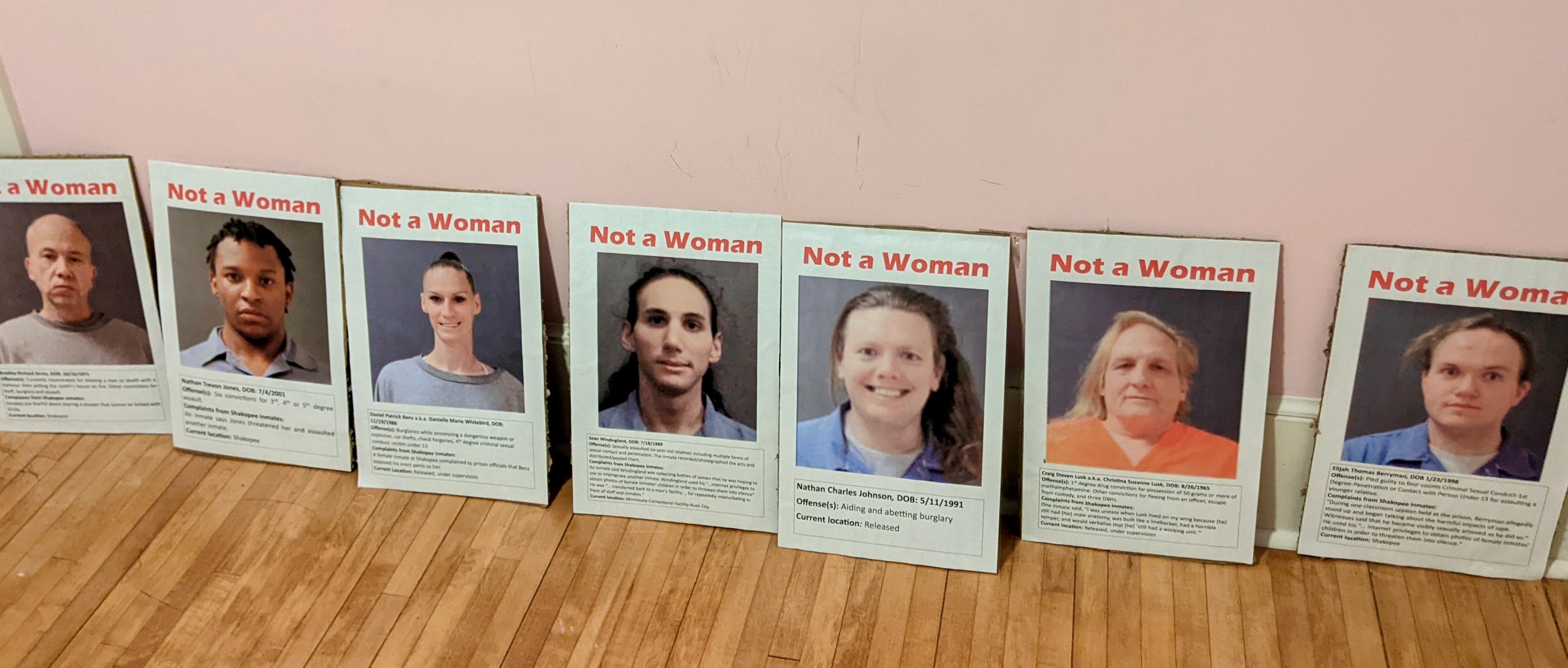
violent convicted prisoners are women and should be housed in the women’s prison (they all have been, some still are), or that Caster Semenya (below, from his autobiography) is a woman with naturally high testosterone. The fact that these pictured people are all male, causing great harm to women, has been actively, even violently suppressed.
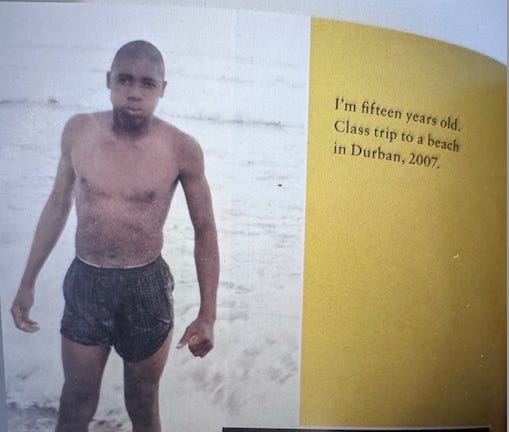
Unbelievers have been vilified, lost their jobs, lost their human rights, have been threatened, slurred, and lied to by kind, empathetic believers for more than a decade. Does that sound like the Crusades? Division is not the problem. Violent suppression of unbelievers, and the notion that they are bad people and deserving of violent suppression is the problem.
We’ve all seen such things play out. There are some people who don’t know me at all, but they hate me because of the views I’ve shared online.
This felt kind of personal, so I was obliged to defend myself. Though I cannot understand how a person, a woman, whose career is writing about female runners, can loudly and proudly say that men belong in women’s sports, and I strongly disagree with some of her views, I have plumbed the depths of my heart and can find no hate for Alison Wade. If she believes men who say they are women, I hope her well-oiled belief system extends to me when I say I do not hate anyone.
There are a number of athletes whom I’ve followed online for years, and moments in their careers that felt like major triumphs for the entire sport, or they were people whose content I really liked. And then the 2024 presidential election happened. For a few days after the election, it seemed like some people in the running community thought Trump’s election meant they could show support for him without consequence. But then, for some, I think there were consequences—losing followers, disappointed messages from fans—so many of those people went back to being quieter Trump supporters.
Wow. That is some weapons-grade self-righteousness. Having established that people hate her, she feels justified in meting out some Old Testament shit. No turning the other cheek for Alison. So certain is she that she is right that she says others should face “consequences” for having the temerity to support a different candidate. Ironically, that statement is grade-A Trumpian: mind-blowingly authoritarian, Mao would have been in awe. It’s easier, and sounds less misogynistic, to say Trump supporters should be punished than it is to say people who support women’s human rights should be punished, so she does, because no one could ever see through her very subtle Trump-washing. No one could ever discern that she really means that people who support women’s sports for women should face consequences, thanks to her skillful deployment of Trump’s name over and over. Apparently Wade has not educated herself about Democrats for an Informed Approach to Gender, or any of the many many lifelong Democrats who know that sex is real, and it matters. Since she brought up the idea that people should face consequences for their beliefs, should she face consequences for supporting an ideology that is, at its core, misogynistic and a giant lie, one that has undermined our free and democratic society? That kind of logic, is not part of Alison’s world.
Here’s where Alison purposely and knowingly lied—that those horribly wrong people who supported women’s sports for women merely “lost followers and received disappointed messages.” JK Rowling would like a word, Alison. Lost followers? That identifies as a consequence. In the real world, people lost their livelihoods. They were physically assaulted. They lost their lives, Alison. By disappointed messages from fans, did she mean this small selection posted on X by JK Rowling?
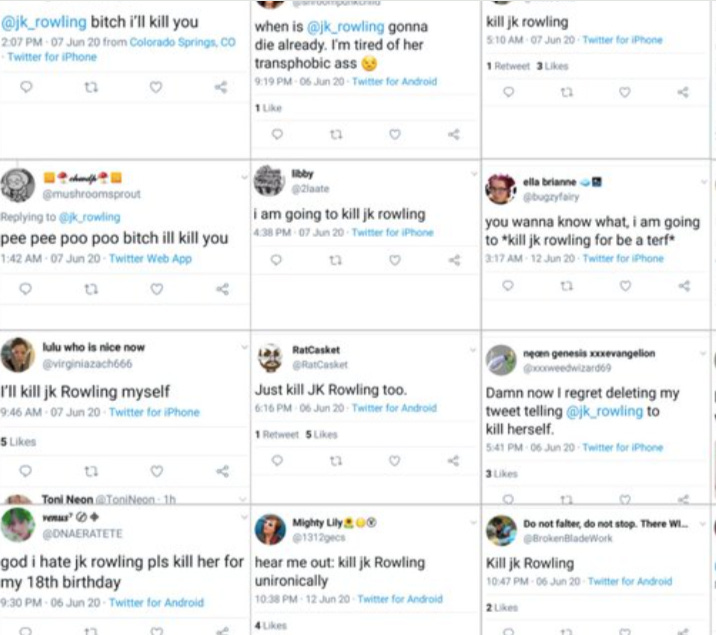
Or did she mean this Sophie Cunningham fan sending his disappointed message to all the women speaking out for women’s sports? I have no patience for Alison’s minimization of the violence women have faced for simply asking for their rights back.
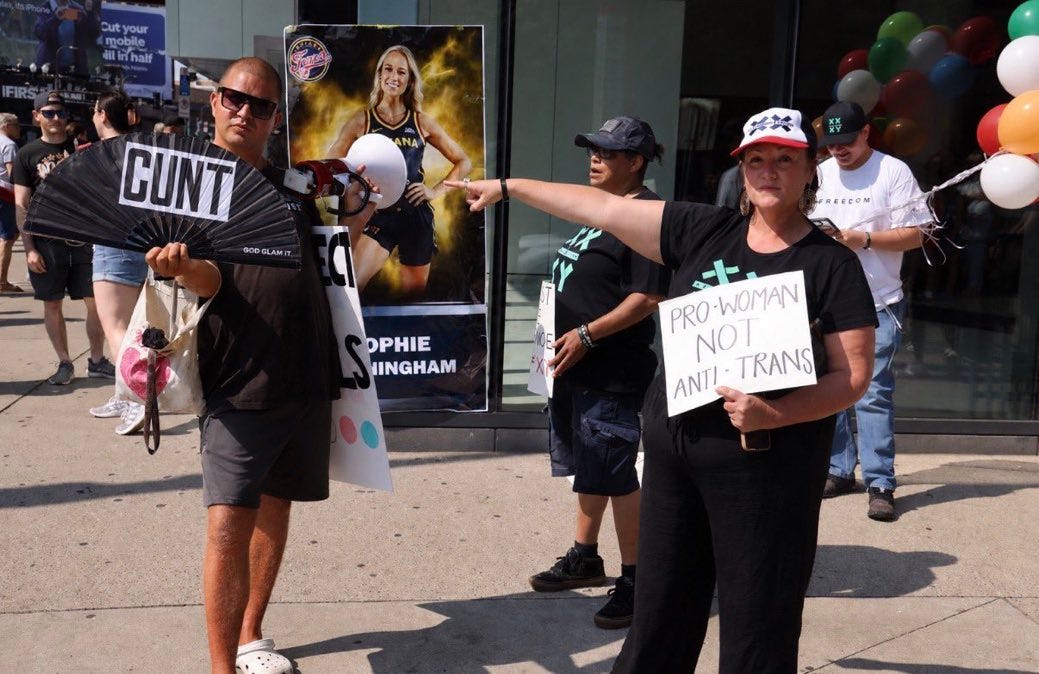
But after that, I couldn’t unsee the fact that quite a few prominent figures in the running community were subtly sharing their political beliefs in other ways: liking posts about Trump winning the election or sending ICE into cities, liking posts about banning trans women from sporting opportunities that they already did not have, and posts from MAGA influencers. I think that, on the whole, the women’s professional running community leans left, but I saw enough that I felt disillusioned about the work I do.
I see my job as highlighting others’ successes, among other things, and for a while, I really lost my enthusiasm for doing that, because it felt like too many of the women I was writing about didn’t have the backs of other women, immigrants, trans people, or other members of marginalized groups.
She was traumatized by other people, runners!, who did not share her view that women should give up their right to sports and spaces to men. It’s, like, actual violence. My god, runners thinking differently about stuff, not many, thank Biden, but enough that she was disillusioned about writing about women and women with penises. She lost her enthusiasm for it, and do you know why? Too many top female runners—how on earth could she write this?!—”did not have the backs of other women…” No words, my friends. No one, not Trump, not Andrew Tate, no one could lack self-awareness to that degree. But Alison does. This is a woman who, nearly every week, bemoaned World Athletics’ moves to ensure a female-only category, at the elite level, referring her readers to a science-less piece of crap produced by Rose/Reo Eveleth , a fiction writer who can neither figure out her name nor her sex, and talked about the poor boys who were booed after they won girls’ state championships. Alison goes on to include in the haters, people who don’t have the backs of “immigrants, trans people, or other members of marginalized groups” reeling off the list of progressive sacred sects who can do no wrong, right after tossing women on the bonfire. Alison is hitting her stride. The stupid is coming fast…
I’d like to say that I reconciled all of that at some point. But there was no grand conclusion; I just decided that if I wanted to do this job, it was going to require highlighting the accomplishments of some people with wildly different views than my own. But I also have choice in what I cover, so in some cases, I’ve tried to profile those who have gone out of their way to stand up for marginalized groups.
Committing to highlighting the accomplishments of even people she doesn’t like. That an adult would write, publicly, that she has trouble writing about a woman who, for example, set an American record if that woman did not also agree with her on ICE, on immigration, on men in women’s sports, on climate change, on gun safety, on virtually every other topic, is the single most bigoted, exclusionary thing I’ve ever seen in print. Jesus wept. That any thinking (and I use that advisedly) adult would be so eye-wateringly narrow-minded and, yes, bigoted, while claiming the opposite, is staggering.
Alison chooses to be the slavering PR lackey for the one woman in elite level track and field who loudly rejects her sex. Nikki Hiltz, Olympian, the U.S.’s top female 1500 meter runner, at various times trans, nonbinary, gay, or queer, but definitely not a woman, as the need for relevance demands, proves that she is, in fact, a woman every time she steps on the track. Wade knocks herself out kowtowing to this very talented woman whose entire career, from high school on, is due to a protected female category, and makes sure to use plural pronouns and censor the facts to conceal the fact that Hiltz won the US National Women’s Championship, and awkwardly, that the event was fair and meaningful because the participants shared the same biology: They were all females in the female category. The one thing Wade’s obsession with the very confused Hiltz does accomplish is to demonstrate that women’s sports is inclusive of ALL women, even the pathologically confused ones, and always has been, and that ensuring the integrity of the female category allows women with trans and nonbinary and queer identities fair competition, whether they want it or not. Wade reminds readers every time she does the mental contortions necessary to present Hiltz as a very special person outside the oppression of the binary that people with trans identities are not and never have been banned from sports. Alison’s sliver-like range of acceptable thoughts no doubt does not allow for that elephant of a consequence.
Some of the stories I’ve written in recent years have led me to talk to people I probably wouldn’t have a lot in common with.
She’s talking about people who believe in gravity.
It’s really easy to make assumptions about people based on very little information. I’ve certainly done it myself. But I find so much more value in phone conversations and in-person interactions, because there is so much more room for nuance and back-and-forth conversation, and I almost always like actual people more than what they post (or signal) online. That’s not to say that we can overcome all of our differences, but the way we show up online is almost always an oversimplification of who we are.
And it’s easy to draw incomplete conclusions about someone’s life based on what they post. If I haven’t seen a friend in a long time, and all they’ve posted is happy photos of their family on vacation, I might assume their life is going great. But when I get together with them—especially if we have the opportunity to run together—that’s when I find out how they’re really doing. I used to say that if you think someone is normal or has no big challenges or family drama, you probably just haven’t run enough miles with them yet
I find it soothing to be informed as to the limitations of social media by an adult who talks about people she likes and doesn’t like. Even though Alison, is, like, my fourth best friend.
Because sharing more online leads to greater divisiveness,
I’ve got bad news for Alison. Nearly 80% of Americans think women’s sports should be for women. That’s so lopsided it doesn’t even qualify as “divided.” We don’t, for example, think of our society as “divided” over the question of whether the earth is globular or flat. And it has nothing to do with digital expression. It just is. Like sex.
I think we’ve increasingly seen high-profile runners and track & field athletes lean toward sticking to vanilla topics that have a chance of being relatable and appealing to all.
Apparently Sophie Cunningham has not pierced Alison’s teeny tiny nonsense-fortified world. Because from that vantage point, anti-logic would take you to…
I imagine many sponsors prefer that. Don’t rock the boat. But for me, that’s a turnoff. My favorite people to follow online are those I can learn from and are consistently vocal about what they believe in.
Again, Alison’s intellect has left me speechless. Ok, I lied. “Turnoffs”—people who are consistently vocal about what they believe in, like women’s sports for women and the reality of sex and stuff. Stuff I don’t agree with. Those people are bad and should face consequences. Like loss of followers. And death threats.
Carr also writes about how young people today are much more likely to socialize online than in person, they’re going out less in general, and that they are lonelier and struggle with their mental health more compared to previous generations. And the phenomenon disproportionately affects women and girls.
Wait wait wait, so Carr is saying tech-induced loneliness mostly affects women and girls. How would he know this group was especially affected? What makes them different? He must be using the new definition of women and girls that includes men and boys, right Alison? In the same way that menstrual cycles, pregnancy, postpartum depression, menopause, and RED-S affect ALL women and girls, right? Your definition of women and girls, right Alison?
I also thought he made a good point about how the widespread use of smart phones and social media has reshaped society. Even if an individual makes the decision to step away from social media, they are still affected by the fact that other people are now less likely to get together in person. Being off social media can lead to further isolation, because you can miss what little interaction there is. (Or, with the demise of local newspapers, sometimes it’s the best way to get information about what’s happening in one’s community.)
Not everything is about running, the sport isn’t for everyone, and it can’t fix all of the world’s ills. But at any age, running can be an excellent way to socialize, and I think it’s one of the easiest ways to get to know new people and see an honest version of who they are. I haven’t been able to run consistently in a long time, which is really frustrating, but I am still a running evangelist because I’ve seen the many ways in which the sport has connected people and changed their lives for the better.
Yes, running connects people in real life, the world of trails and sweat and intestinal distress. Runners are uniquely and intimately connected to the reality of their bodies, their amazing potential and their limitations. You don’t identify as having run seven miles; you either did or you didn’t. There’s no “division” about this. You can believe in time and distance or not, but that does not change the fact that they exist. They are real. Sex is real. Running is one of many ways we are tethered to our biology, each other, our humanity, reality. The “divisiveness” part comes when a swath of people try to deny that stuff. Or, as Alison sees it, when people don’t think “trans girls”are girls.
Sure, I’ve occasionally run with people who, as I’ve gotten to know them better, I’ve started to like less. But for the most part, the sport has helped me to have much deeper conversations with people than I otherwise would, and most of the time, it makes me feel greater empathy for them and like them more. If you’re someone who has the privilege of being able to run with other people, it’s an excellent antidote to our increasingly online lives.
Have you noticed how often Alison has mentioned not liking or liking people? I went back and bolded all of them. Which, as she has said, is synonymous with whether they agree with her on women (specifically, that they do not deserve their own sports), “trans” athletes, ICE, political candidates, immigrants, and other marginalized groups. It’s remarkable. Again, I’m going to disrespect third-graders here, but I have read essays on favorite/least favorite foods that have not used the terms like and not like as frequently. And the scholars in Miss Baer’s class have been able to parse out the difference between liking, agreeing, and complying, and between disagreement and hate. And to put a finer point on it, between criticism and hate. Alison has not.
Disagreement is a two-way street: Since Alison has equated disagreement with hate, if she doesn’t agree with people who think a female category for females only is a good thing, does she hate them? The list of people she doesn’t agree with on ICE, immigrants, other marginalized groups, climate change, gun rights, reproductive rights, etc gets pretty long. Does she hate all of them? It’s almost as if Alison is creating a world of divisions: people she likes and people she doesn’t, people who think like her and everyone else, people who deserve to suffer the consequences of their beliefs (did that include Charlie Kirk, Alison?) and people who are right. That’s a scary world. Luckily, it’s not reality.
Yikes.
Thank you, Sarah.
It’s quite the illiberal mindset one must have entrenched to feel it appropriate to share such narcissistic and juvenile material as a professional output 🤦♂️
Have you no self-awareness, Wade?
Being a true believer in TWAW, coupled with the disconnection from the material reality of being female never fails to be astonishing. Athletes should really know better: it really demonstrates the level of ideological capture.
Capital, not capitol, punishment.