

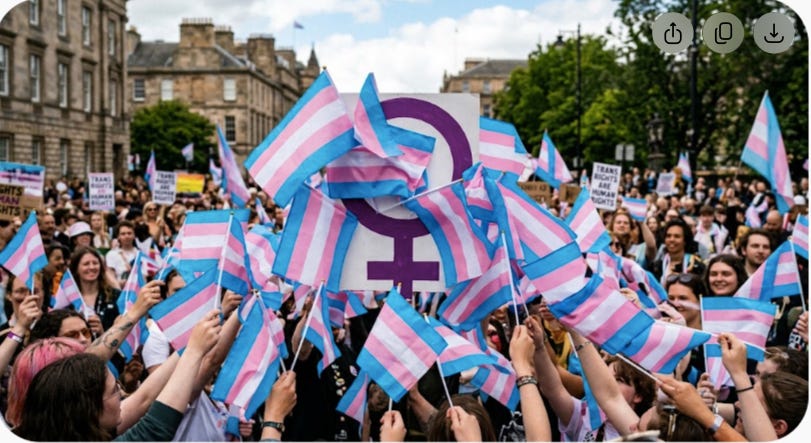
We hear it all the time, the oft-referenced statistic that about 79% of Americans support single-sex sports and locker rooms, including 67% of Democratic voters. That supermajority responded anonymously to a NY Times poll, but when it comes to voicing public support, that supermajority goes super quiet. They stay home, while the super minority of trans supporters show up at a disproportionately high rates.
Dr. Greg Brown is a Professor of Exercise Science in the Department of Kinesiology and Sport Sciences at the University of Nebraska at Kearney. He has not only authored many studies of sex differences in sport, especially pre-pubertal sex differences, he has served as an expert witness in legal cases and speaker in support of sex-separated sports. Here, he explores a recent experience with the dangerously misleading disparity in public engagement between proponents and opponents of single-sex sports. It is a call to public action.
The Gender Wars Are Far From Over — Even in Conservative Nebraska
The controversy over males who identify as girls or women (“transwomen”) competing in female sports continues to generate headlines, particularly in Democratic-leaning states. Recently, in Washington, female cross-country runners walked off the course in protest of a male competitor in their race. In Oregon, spectators wearing shirts and holding signs advocating for sex-based eligibility in women’s sports were removed from a professional soccer match, while those antagonizing them and waving transgender pride flags were allowed to remain. And in Minnesota, demonstrations outside of a WNBA game highlighted the contentious battle over transgender participation in women’s sports.
But surely the battle has been won in conservative states like Nebraska, right?
After all, in 2025 Nebraska enacted legislation protecting sex-separated athletics, and voters will have an opportunity this November to make those protections even more durable through Initiative Measure 442. Known as the Fairness for Girls initiative, the proposal would amend the state constitution to protect sex-separated athletic competition in Nebraska schools and colleges. Supporters submitted approximately 211,000 petition signatures to place the measure on the ballot, almost twice as many as the number required and a record for a Nebraska ballot measure.
That certainly sounds like an issue with substantial public support.
But an experience I recently had in Kearney, Nebraska, made me wonder whether those of us who believe the female category in sports deserves protection might be getting a little too comfortable.
As part of the ballot initiative process, Nebraska law requires the Secretary of State’s office to conduct public hearings in each of the state’s three congressional districts. One of those hearings was scheduled for Thursday, October 22 in Kearney, Nebraska, which is where I live.
So, that evening, I headed to the Buffalo County Extension Building at the county fairgrounds to attend the hearing and offer my support for Initiative Measure 442. I wasn’t quite sure what to expect.
There were no protesters outside the building. I didn’t see any police or sheriff’s vehicles in the parking lot. And I did not notice any law enforcement officers inside the building. In fact, the only indication that anything unusual was happening was a sheet of paper taped to the glass entrance door announcing the hearing. Inside, things were equally uneventful. I noticed one person wearing a rainbow flag standing in the foyer, but otherwise there was little to suggest that a controversial political issue was about to be discussed.
A folding table held sign-in sheets for members of the public wishing to testify, either as proponents, opponents, or neutral of the initiative. A friendly representative from the Secretary of State’s office was available to assist with signing in and to remind attendees that informational pamphlets about the ballot measure were available.
The hearing room was far from full. And unlike what one might expect at a contentious political hearing, there were no obvious opposing camps sitting on opposite sides of the aisle. It was just a modest gathering of Nebraskans on a Thursday evening.
Former Nebraska state senator Julie Slama, one of the initiative’s sponsors, presented the opening statement in support of the measure. Although allotted ten minutes, she spoke for only a few.
An attorney representing an LGBTQ nonprofit organization then delivered the opposition statement, using nearly her entire ten-minute allotment.
Then came public testimony.
I wasn’t surprised when my name was called as the first member of the public to speak in favor of Initiative 442. After all, when I signed in, there were no other names on the proponents’ list. I gave my testimony and returned to my seat, expecting that other supporters would have signed up after me.
Apparently not. I was the only member of the public who had signed up to speak in favor of Initiative 442!
With no additional proponents to provide testimony, the opponents were given the floor, one after another. And while the overall turnout for the hearing was rather small, the opponents certainly made full use of their allotted time. Approximately ten people testified against the initiative, including representatives of LGBTQ nonprofit organizations and advocacy groups, a female physician who had driven over 3 hours to be there, two female college students, and two men who identified as women.
The arguments were familiar. I emphasized the importance of maintaining a female athletic category based on biological sex. Opponents argued that “transgender” (male) participation in female sports is exceedingly rare and that restrictions could negatively affect these students’ mental health. And, of course, some opponents resorted to disparaging characterizations of supporters, questioning our humanity, suggesting we were simply mean-spirited, and even raising questions about Riley Gaines’ swimming ability. There was little new in the arguments, and rehashing them is not the purpose of this essay.
What struck me was something else entirely.
Here I was, in Kearney, Nebraska, where registered Republicans outnumber Democrats by almost 4 to 1, and opponents of a measure protecting sex-separated athletics outnumbered supporters in public testimony by roughly ten to one.
What made this particularly striking was the contrast with a 2023 Kearney Public Schools hearing concerning a proposed policy requiring sex-separated athletic competition. At that hearing, the room was packed, with people standing in the hallway and even down the stairs. Forty-seven people signed up to speak, and all but two of them supported the policy.
Same community. Essentially the same issue. Yet two public hearings produced dramatically different pictures of public sentiment. Remember, supporters had collected approximately 211,000 signatures to place this measure on the ballot. Yet I was the only member of the public who showed up to speak in its favor at this hearing.
Now, public hearings are not scientific polls. The number of people who attend and testify does not necessarily reflect public opinion. But consider how this might appear in a news report. A reporter could accurately state that public commentary was approximately 10 opposed to 1 in favor. Indeed, the Daily Nebraskan news report of the hearing in Lincoln states that 20 people spoke in opposition to Initiative Measure 442 with no mention of how many spoke in favor. To someone unfamiliar with Nebraska politics or the petition campaign, that could easily create the impression that opposition to the measure was overwhelming.
And what about policymakers? When elected officials repeatedly hear from one side of an issue while hearing little from the other, could that influence their perception of public opinion? When supporters of sex-separated athletics are largely absent from public hearings, their perspectives receive less public attention, while the opposition’s arguments dominate the discussion.
Perhaps some supporters assumed the initiative would pass and saw no need to attend. Perhaps others were unaware of the hearing or had more pressing obligations. I don’t know, and I certainly cannot conclude from one hearing that this imbalance exists everywhere. But the experience raises an important question about the broader debate over the female category in sports: Are public hearings reflecting what people actually believe, or simply who is motivated enough to show up? Make no mistake about it: Those who oppose sex-based sports policies are organized, motivated, mobilized, and willing to make their voices heard, and increasingly those voices are vile and threatening.
In recent years, there have been significant positive developments in the courts, state legislatures, and athletic governing bodies concerning sex-based categories. It might be tempting to conclude that the major battles have been fought, and the issue is largely settled. The hearing in Kearney suggests otherwise.
For those living in states that have already mandated protections for female athletics, the continuing public debate raises questions about how durable those protections will prove to be. For those in states where such policies remain contested, Nebraska illustrates that even substantial petition support does not necessarily translate into a visible presence in public discourse.
My experience in Kearney was a reminder that public opinion, political organization, and participation are three different things. And perhaps the most important lesson is this: While a few victories to protect the female category have been won, the fight is far from over.
If the hearing in conservative central Nebraska is any indication, the gender wars still have many battles left to be fought. And the voices heard in those debates need to include moms, dads, brothers, sisters, aunts, uncles, grandparents, and, most importantly, female athletes themselves who want to protect female-only sports. The experience in Kearney was a reminder that even strongly held convictions can go unheard when those who hold them stay home.
The climate for speaking truthfully is awash with abuse. Women, and some men as well, have paid a high cost for speaking truthfully. Some have lost their careers. Some have had their families destroyed. Some are afraid of alientating their own children further so chose to not publically speak. Some have been physically attacked, etc. etc. The transgender activists have absolutely succeeded in bullying women to do as they wish. The cost to speak publically is very high. Billboard Chris states he has been attacked 25 times, 3 of those resulted in a broken arm. Riley Gaines had to barricade herself in a classroom for 3 hours due to threats of physical violence after speaking at SFSU. This behavior has been deemed acceptable by the powers that be. Women are attacked for saying that no man can be a woman, while these men walk around in public with signs that say "Kill all Terfs". They are even allowed to display violent artwork in public buildings calling for violence against women. Shaming people for not speaking in public is not the answer. These violent activists need to be held accountable for their behavior if we are to expect people to feel safe to speak in public. Over the weekend, we again saw trans activists physically attacking a group of people for wearing XX-XY shirts. The people doing the physcial harm were not removed from the building. The people wearing XX-XY shirts were. Its lopsided because the unacceptable and illegal behavior from the transgender activists goes unchecked and unpunished.
"80% of success is just showing up ". Woody Allen
It's what allows for the tyranny of a miniscule minority.