

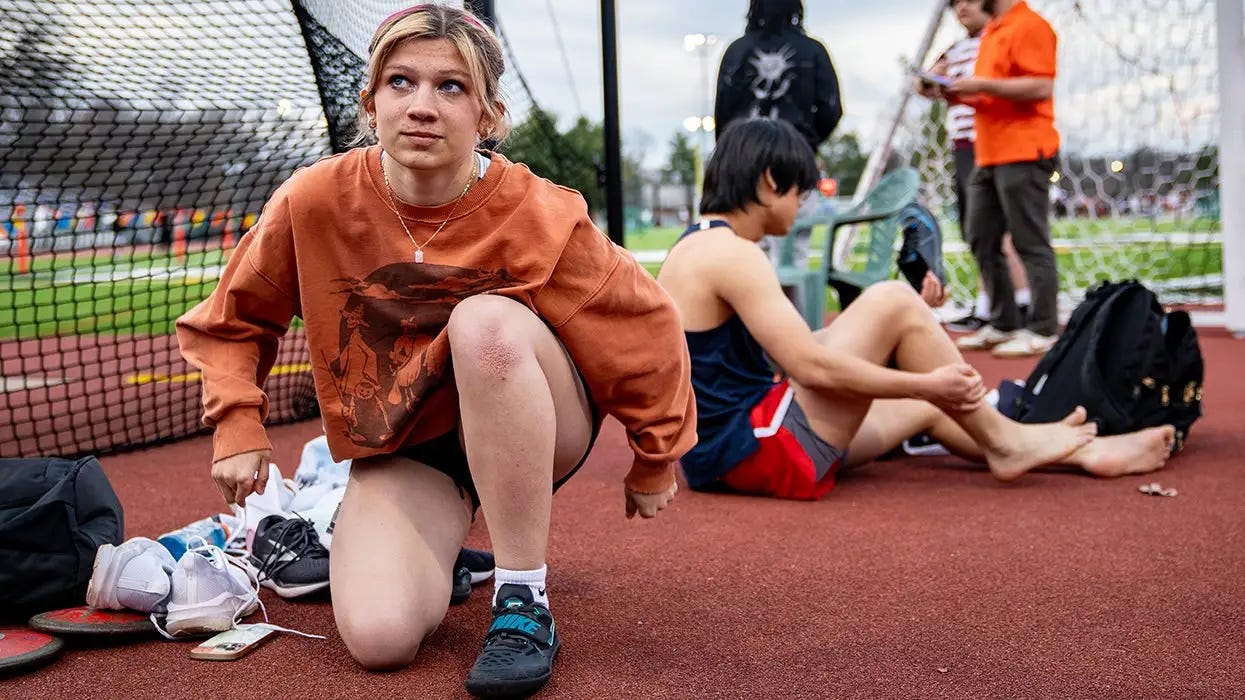
Allison Robbert for The Washington Post via Getty Images
The Williams Institute at UCLA researched and published a report on The Impact of Transgender Sports Participation Bans on Transgender People in the US. The “bans” they talk about are laws requiring that people with trans identities compete in sports according to their sex, see also: Title IX. Below are their findings regarding benefits of sports and risks of “exclusion.”
Benefits of Sports Participation. It has been correlated with higher levels of self-esteem, lower levels of depression, and greater school belonging among LGBTQ youth. 73 Additionally, one study found that transgender and nonbinary students who participated in sports reported higher grades compared to those who did not participate. 74 Another study found that transgender students who participated in collegiate sports may be less likely to report psychological distress, self-harm, suicidal thoughts, and suicidal behavior compared to transgender students who did not participate in sports.75 If transgender girls and women are not allowed to participate in sports based on their gender identity, they could be denied these and other benefits.
Risks of Exclusion. Exclusion from sports could also result in discrimination or harassment for transgender students. A recent study using YRBSS data found that transgender high school students report disproportionate bullying, persistent hopelessness, and suicidal ideation compared to cisgender students.76 Evidence suggests that transgender students in higher education may also experience greater levels of harassment and discrimination, have a more negative perception of campus and classroom climates, and feel less accepted as part of the campus community compared to cisgender students.77 Any of these disparities could be made worse if transgender students are denied participation in school sports or forced to participate consistent with their sex assigned at birth under a federal ban.
The authors cited studies that support both benefits and risks of exclusion, which are all equally applicable to ANY child regardless of identity or lack thereof, but they editorialized on the final and most important sentence in each section—that these benefits could be denied and risks enhanced if children were “forced” to participate in sports consistent with their sex.
There was no supporting evidence of that. No citation. Their evidence compared suicidal thoughts and behavior in trans students who participated in sports versus trans students who did not participate in sports. The studies did not compare trans-identified kids who participated in sports according to their gender identity with those who participated according to their sex. The Williams Institute deliberately left out the fact that the benefits of sports can, and have been enjoyed by participating in one’s sex category. Another compared rates of bullying, hopelessness and suicidal ideation among trans-identified students versus not-transgender identified students. Again, unrelated to any kind of sports involvement at all. The risks of “exclusion from sports” mentioned were the experiences of trans students because they were trans—nothing to do with involvement in sports. Their own evidence suggests these risks were irrespective of sports. It’s a pretty massive, unevidenced, and misleading leap to blame suicidal behavior, lower grades, depression, and lack of belonging on the trauma of playing sports in accordance with one’s sex. But that’s what the Williams Institute did.
Since sex-separate sports have been the law in 27 states for at least a year, I reached out to the Williams Institute to see if they had qualitative information on trans-identified kids (Williams Institute focused on kids ages 13-17, high school age) living in those states. Had those kids quit sports? Or had they joined sports in accordance with their sex? Had kids in these states been denied the benefits of sports, and experienced the enhanced risks the Williams Institute said would happen since they “were forced” to play on the correct sex team?
Remember the story the Washington Post did on trans-identified male high schooler Eliza Munshi in April of 2025? A senior at a Falls Church, Virginia high school, Munshi originally joined the girls’ track team, but just days into the season he was told he could no longer participate on the girls’ team because the Virginia High School League was following the Executive Order that upheld Title IX’s sex-based requirements. Them, an LGBTQ news site, wrote:
Not wanting her participation to negatively affect her friends on the girls’ team, Munshi told her coach she would compete on the boys’ team instead. She told the Post that despite the policy changes, everyone at her school has continued to make her feel welcome. “Sometimes I forget I’m transgender. People around me forget too,” she wrote last year in a college admissions essay, per the Post.
According to the Post, Munshi was not very competitive in the boys’ discus (he could have been a mediocre athlete, or he could have hobbled his ability with puberty blockers) in which he competed, but overall he seemed well adjusted, satisfied with his experience, and enjoying all the benefits of sports—camaraderie, friendships, challenge, and physical activity—even though he was not competing in alignment with his gender identity. He didn’t express negative feelings, depression, or not belonging. Quite the opposite. He felt welcomed on the boys’ team, and more importantly, everyone else, boys and girls, was fine with it too. No unfairness, he wasn’t taking anyone’s spot or opportunity, and his teammates welcomed him as a boy who identifies as a girl. Which is to say, as his authentic self. By all accounts, a roaring success of inclusion.
But I’ve never read another story like this. Certainly, Munshi’s story does not support the Williams Institute’s dire claims, but maybe he was an outlier. Maybe Williams Institute had lots of stories of kids in those 27 (it’s now up to 29) states that mandate sex-based sports who are dropping out of sports, reporting increased depression, lower grades, suicidal thoughts and behavior. Stories of a steep decline in mental and physical health. Stories that supported their claims of bad things that could happen if kids were denied the ability to choose what team they wanted to play on. One would think this would be an important piece of Williams Institute’s research.
Nope. Williams Institute does not gather qualitative data. Only quantitative—they keep track of numbers; the number of trans kids affected, not how they were affected. (I’ll get to some fun with their numbers a little further down). The very responsive communications agent at Williams Institute suggested I try Athlete Ally for the qualitative informative I sought. Athlete Ally also didn’t have that info, and pointed me to The Trevor Project or GLAAD. More on that in a minute.
This gaping hole in Williams Institute’s research seems very strange. If what the Williams Institute claimed could happen was actually happening, and hundreds of thousands (yes thousands per their research, not one or ten—I’ll get to that) of trans-identifying kids were quitting sports and getting lower grades and really failing to thrive, and Williams Institute had these personal stories of the damage caused, imagine how powerful that would be. It’s almost incomprehensible that they wouldn’t have this information. Almost like they don’t want to know how kids with trans identities are actually faring when “forced” to do sports according to their sex. What if they were like Eliza Munshi? What if all that bad stuff Williams Institute claimed could happen, wasn’t happening?
The Trevor Project
The Trevor Project bills itself as a suicide prevention and crisis intervention organization for LGBTQ+ youth. If you’re a hammer, every problem is a nail. “LGBTQ young people, especially trans youth, are four times as likely to [I missed it—either contemplate or commit] suicide. We should really be working hard to make sure they can be part of a team and valued for who they are.” That, from Casey Pick, Director of Law and Policy at The Trevor Project.
Full disclosure: The only reason I was able to talk with Casey Pick at all is because, on the contact form, I correctly identified my title as “freelance journalist” but fibbed in the field that asked the outlet for which I was working. I entered the name of an LGBTQ news site. Hear me out—several times over the course of our exchange, I reiterated that I was a freelancer, that I did not have an assignment from said outlet, and was writing an article on spec. The article I was writing had not been accepted anywhere. Assuming I was an LGBTQ “journalist,” Pick spoke easily, confident I would accept anything she said unquestioningly. I felt a little bad about my fib. But not that bad.
Immediately after our conversation, I scampered on over to The Trevor Project’s Suicide Facts web page. Five of the eight facts about suicide specifically compared LGB youth with heterosexual youth. The T, trans youth, were not included in those statistics. Pick’s “four times as likely” did not agree with any of their facts—contemplate suicide, three times as likely as heterosexual youth; attempt suicide, five times more likely; suicide attempts requiring medical treatment, five times as likely; suicide attempts resulting in injury, poisoning or overdose, 4 to 6 times as likely; suicide attempts because of family rejection, 8.4 times as likely. All of those facts specifically applied to LGB youth, not transgender. The only fact involving trans individuals was that 40% of trans adults had attempted suicide, and 92% of those attempts were made before age 25.
AS HORRIFIC AS THESE SUICIDE STATISTICS ARE, IT’S BEYOND UNCONSCIONABLE TO MISREPRESENT AND MISUSE THEM FOR POLITICAL PURPOSES. Not only was the “four times more likely” statistic Pick quoted me incorrect according to their own research, it did not apply to trans kids, and most importantly, there was zero evidence that kids with trans identities contemplated or attempted suicide because they could not participate in sports in accordance with their gender identity. Yet, Pick repeatedly made that connection. Just like the Williams Institute.
I told Pick I was looking for qualitative data on how “sports bans” (when in Rome…) affected transgender youth. Did they quit sports? Did they join sports according to their sex? Did they move out of state? Did they report increased depression? Pick said The Trevor Project had “qualitative impressions,” but that she had not done the “cross sectional work” to answer those questions directly. From there she launched into a practiced, and largely irrelevant, script : “They’re demonized as cheaters, as dangerous. All they want to do is participate in sports with their classmates for all the same reasons as their classmates—for fun, for a sense of belonging,” She mentioned that only one in three LGBTQ youth participated in sports but did not have stats on just teens with trans identities, nor a comparison of those who live in states where trans-identified teens can play according to their gender identity with those who live in states with sex-separated sports.
So, no, The Trevor Project does not know how the 382,800 trans-identified teens in states where Title IX is honored are affected because of the so-called sports bans. Maybe those teens have responded like Eliza Munshi. If so, it’s unlikely a trans-identified athlete like Munshi would have called in to The Trevor Project’s suicide prevention hotline—the source of their “data”—to tell them he’d joined the boys’ team and was busy getting all those sports benefits, thank you very much. The information they have, like the Williams Institute’s, describes possible harms that apply to virtually ALL teens who are not participating in sports, and includes trans-identified teens living in states where they can participate according to their gender identity. Blaming sex-separated sports policies for any LGBTQ+ youth, of any age, living in any state, who is distressed enough to call The Trevor Project suicide prevention hotline, not participating in sports is unevidenced, unscientific, and irresponsible.
Fun With Numbers
So I came up empty on what kids ages 13 to 17 with trans identities who live in the 29 states that mandate sex-based sports participation are actually doing. But Williams Institute just published an updated report titled the Impact of 2025 State Anti-Transgender Legislation on youth. This updates the report that I linked to way up above that they published in February 2025. I surmised because of the Executive Orders, fewer kids would even identify as trans, or fewer of those who did identify as trans would participate in sports because they’d have to play in their sex category. But that’s not what the numbers showed at all.
The Williams Institute report published in February 2025 stated there were 117,400 trans-identified kids age 13-17 who lived in the 27 states that mandated sports participation by sex. They used federal Youth Risk Behavior Survey (YRBS) data that estimated 40.7% of trans-identified high schoolers nationally participate in sports. But there was no comparison of the rates of trans participation in sports in states with gender self-ID versus states with sex-separated sports.
If you’re researching the impact of “sports bans” on trans-identified kids, comparing the rate of participation between states that allowed gender self-ID and those that followed sex-based standards would seem to be THE most relevant data point. But Williams Institute did not run that comparison.
“Because YRBS is national data, we would have had to figure out participation rates state by state,” said Elana Redfield, Director of Policy at Williams Institute. “Some states would have a 20% rate of participation, others 50% , and not all states submit that data. It doesn’t justify analysis. The sources are too limited to be able to do analysis. It’s not off the table that we would never do it, but it wouldn’t be applicable to understanding the policy environment.” Huh.
Redfield admitted they don’t know how many trans-identified kids aged 13-17 are actually participating in sports, nor if they are participating according to their gender identity or their sex. “There are a lot of unknowns, but the YRBS data shows in general trans kids have low participation rates. We have to be careful not to over-estimate when in reality, the rates are very low. We’re trying to show what we can by using rigorous scientific methods.” Again, since they were showing the impact of sports bans, one would think rates of participation in sports would be absolutely key.
The latest Williams Institute report, published in January 2026, did include some eye-popping updates. Their updated data showed an astounding 382,800 transgender youth ages 13-17 living in 29 states that mandate sex-based sports participation. Even adding in the 20,367 trans-identified kids in Alaska and Virginia (the two additional states not included in the 2025 report) to the 117,400 counted in 2025, brings the number up to 137,767 in 2025. That's still less than half the number of trans-identified kids listed in the most recent report. How could the number of trans-identified youth ages 13-17 living in those 29 states that enacted “anti-trans legislation” more than double, from 137,767 to 382,800? If anything, one might expect the number of kids identifying as trans in states that had “anti-trans” laws to drop. Not more than double.
Turns out it’s a combination of using Biden-era data when talking about Trump-era “sports bans.” Elana Redfield explained that the 2021 and 2023 YRBS data, under the Biden administration, encouraged collection of students’ gender identity and sexual orientation. That resulted in “improved data.” Their estimate of trans-identified youth ages 13-17 nationwide more than doubled from 300,100 to 724,000. That’s a ton more kids affected by “anti-trans legislation.”
Remember all the times you’ve heard activists and activist media say “there are so few” trans-identified athletes? That some states have one, or none? This table in the most recent Williams Institute report says something quite different.
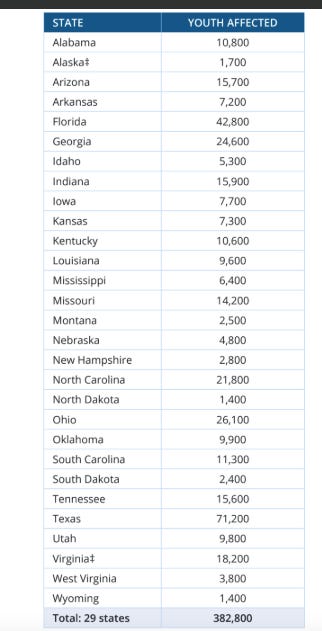
This shows the number of trans-identified kids ages 13-17 in each of the 29 states that mandate sex-based sports participation. It’s a lot. This is when the Williams Institute finds it useful not to know the rate at which trans-identified teens participate in sports. “It could be 20% or 1% or .001%,” Redfield said. Nonetheless, these numbers seem pretty high—71,200 trans-identified teens in Texas, a state that has never been a bastion of liberalism? Even if only 1% participate in sports, that’s 712 trans athletes who, if they’re following Texas law, are participating in their sex category. And not a single story in the news of dire harms from participating in one’s sex category.
Recall when the ACLU claimed in front of the Supreme Court that West Virginia’s law upholding sex-based sports affected only one person—their client, Becky Pepper-Jackson? Well huh. The Williams Institute found that that law affects 3,800 trans-identified kids in West Virginia. Even if only 1% of those kids played sports, that’s still 38 kids. Not just one. Remember Charlie Baker testifying before Congress that there were “less than ten” trans athletes in the NCAA? The Williams Institute stated that it’s “unlikely that transgender athletes make up more than 1.3% of the overall college athlete population.” Using that 1.3% of the NCAA’s total athlete population of 554,000 results in 7,202 trans-identified athletes. Not less than ten.
Which is it? Are there so few trans athletes? Or are there thousands, hundreds of thousands? It seems like there’s another calculus trans advocacy groups are using that is variable. If they’re talking about girls’ right to their own sports and locker rooms, then there are so few “trans” athletes as to be insignificant. They are talking about males of course: They know trans-identified females are not a threat anywhere so there’s no point in counting them, especially in this instance where they need the numbers to be “so few.” If they’re talking about the demands of “trans” athletes to choose the team they’d like to play on—and here, trans-identified females are useful—then it’s a huge number who are being denied this invented “right.”
Fun with statistics. Or is it lying with statistics? I always forget. The Williams Institute does not restrict their statistical magic to sports. They recently published a report on the impact of the Eaton fire in California on the LGBTQ+ community. The California Globe read that impact report closely, as I did with the impact of “sports bans,” and also found some unevidenced claims and unscientific methods (improved data?). The Williams Institute report showed that the LGBTQ+ community was more negatively affected by the fires than non-LGBTQ residents, and that this suffering was due to discrimination, because of their sexual orientation or gender identity. For example, the report noted that larger numbers of LGBTQ people sought legal advice about their rights as tenants, inferring that their rights were disproportionately being abused because of their identity or sexual orientation. In fact, more of the LGBTQ community rent rather than own their homes as compared to non-LGBTQ people. Renters of every stripe were more likely to seek legal advice on their rights as tenants; it was not a bane visited on LGBTQ+ individuals because of their identity. Harms suffered and hassles with insurance companies that happened universally after the fires were attributed to discrimination based on LGBTQ+ identity.
Williams Institute’s methods, too, were unscientific at the very least. They invited members of the LGBTQ+ community to two “listening sessions,” one in May and one in September. Not surprisingly, participants claimed their troubles multiplied when insurers and other service providers found out their sexual orientation or gender identity. Fueling victimhood, leaders of the September listening session read the claims of the May participants out loud. None of this is scientific. It’s not even ethical.
I’ve digressed. My point is, the Williams Institute, The Trevor Project, and other so-called research organizations, are making unevidenced, unscientific, and irresponsible claims. There is every chance that a significant portion of the 382,800 trans-identified 13-17-year-olds living in states that mandate sex-based sports are, in fact, quietly enjoying the benefits of sports like Eliza Munshi did—consistent with their sex. The Williams Institute really really doesn’t want you to know that.
Couple questions.
Since "It has been correlated with higher levels of self-esteem, lower levels of depression, and greater school belonging among LGBTQ youth" for trans girls to participate in girls sports leagues, what are they doing for all the trans boys, pretty much none of whom will be able to earn a spot on the boys teams? Are they also playing on the girls teams? Or are they just shuffled aside in this debate despite the fact that they must be suffering all the same mental distress the trans girls would be if asked to participate with people of the same birth sex?
Also, has anyone bothered to survey the girls who have been displaced by having male born people on their teams or who have self excluded due having boys in their locker rooms? What about their self esteem, happiness or sense of belonging?
I would ask about the "cis" boys, but they seem pretty much largely unaffected by any of this.
We keep being told, "This isn't relevant because it's such a SMALL NUMBER of 'trans' athletes!"
Well, if their presence isn't important, than neither is their purported suffering. Let's instead focus on the large number of women and girls whose lives are being negatively affected by the incursion of men onto what should be single-sex sports teams.
I know the gender ideologues want to have it both ways, but they can't. "Trans" athletes either matter or they don't.