

The Central Nebraska Connection to a Supreme Court Decision
By Greg Brown
This essay was originally published on Forward Nebraska. This version contains a few more details that led to the author’s involvement in the issue of males competing in the female category.
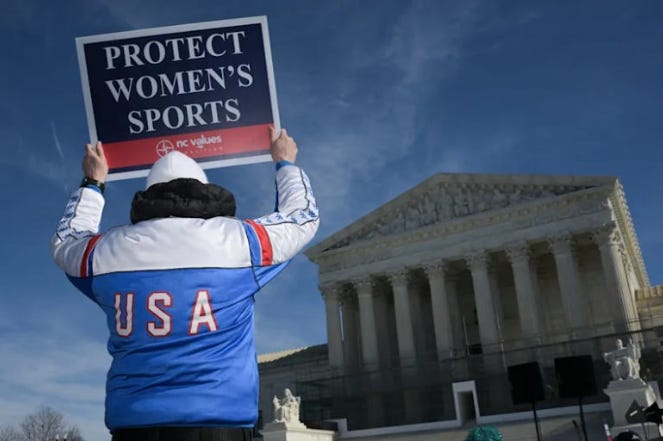
On June 30, 2026, the U.S. Supreme Court issued one of the most significant decisions in the history of women’s sports. In a joint decision for the cases of West Virginia v BPJ and Little v Hecox the Court held that states may constitutionally limit participation in girls’ and women’s sports to athletes who are biologically female. Importantly, however, the decision does not require states to do so. Today, 27 states have enacted laws protecting female sports, while 23 have not.

Contrary to much of the public rhetoric surrounding these laws, the decision does not prohibit anyone from participating in sports. It does not ban transgender athletes from competition. Rather, it recognizes that states may require athletes to compete in the category corresponding to their biological sex. Like age divisions and weight classes, sex based athletic categories exist because they promote fair and safe competition.
For me, this Supreme Court decision is also deeply personal.
My involvement began in 2019, not in a courtroom, but in my classroom at the University of Nebraska at Kearney. After CeCé Telfer won the NCAA Division II women’s 400 meter hurdles national championship, several of my exercise physiology students asked a straightforward question: Does male biology still matter in athletic performance after a male undergoes transgender hormonal interventions?
Before CeCé Telfer won the NCAA Division II women’s 400 meter hurdles championship and my students began asking questions about males competing in women’s sports, I was certainly uncomfortable with the NCAA and International Olympic Committee policies allowing males into the female category. But I also assumed I must be missing something. I thought perhaps there was important research on testosterone suppression that I had not seen, or that the NCAA and IOC had access to evidence that had not yet been published. In other words, I trusted that the experts knew something I did not, or that if these policies were scientifically indefensible, prominent exercise physiologists would be speaking out. Besides, I was just a professor at a regional public university in central Nebraska. What difference could I possibly make?
As an exercise physiologist, I realized I could answer that question scientifically. As I began examining the scientific literature more carefully, I realized I was not overlooking some hidden body of evidence. Biological sex influences athletic performance in ways that extend far beyond circulating testosterone. Instead, I found that remarkably few scholars were willing to publicly question, let alone oppose, the prevailing narrative supporting the inclusion of biological males who identify as girls or women in the female sports category, despite the growing body of physiological evidence raising questions about those policies.
Around that same time, I saw news coverage of Selina Soule and her lawsuit challenging the policy of the Connecticut Interscholastic Athletic Conference that allowed males to compete in girls’ sports. The plaintiffs were being represented by Alliance Defending Freedom (ADF). The timing seemed almost providential. I contacted Alliance Defending Freedom and asked whether they needed an exercise physiologist. I had no idea where that email would lead, but it turned out to be the beginning of a journey that eventually reached the United States Supreme Court. Once I became involved, I felt a responsibility to continue speaking wherever I believed my scientific expertise could be helpful.
That decision ultimately led me to serve as an expert witness in several legal cases. Since 2020, I have prepared expert reports in Hecox v. Little, BPJ v. West Virginia, and other lawsuits involving women’s sports. Along the way, I have testified before legislative committees in multiple states and published numerous scholarly papers examining the role of biological sex in athletic performance and women’s sports.
My wife supported my decision from the beginning. She believed, as I did, that standing up for scientific truth was worthwhile. Neither of us, however, anticipated how much this issue would come to shape my professional life over the next several years. At the time, very few exercise physiologists, or scientists in closely related disciplines, were willing to publicly state what decades of exercise physiology research had consistently demonstrated.
The academic environment made doing so professionally risky. Diversity, Equity, and Inclusion initiatives had become deeply embedded throughout higher education, and publicly challenging prevailing views on transgender participation in sports carried the potential for significant personal and professional consequences. The attorneys I worked with from ADF, along with attorneys representing the states of Idaho and West Virginia, warned me to expect criticism online, in person, and possibly within my own profession.
I do not recount this to portray myself as courageous or heroic. Rather, it was simply a point in my career when I had to decide whether remaining silent was compatible with my responsibilities as a scientist and educator. I concluded that scientific evidence had to take precedence over political correctness. Looking back now, I remain convinced that it was the right decision.
The scientific principles underlying my testimony were and remain straightforward.
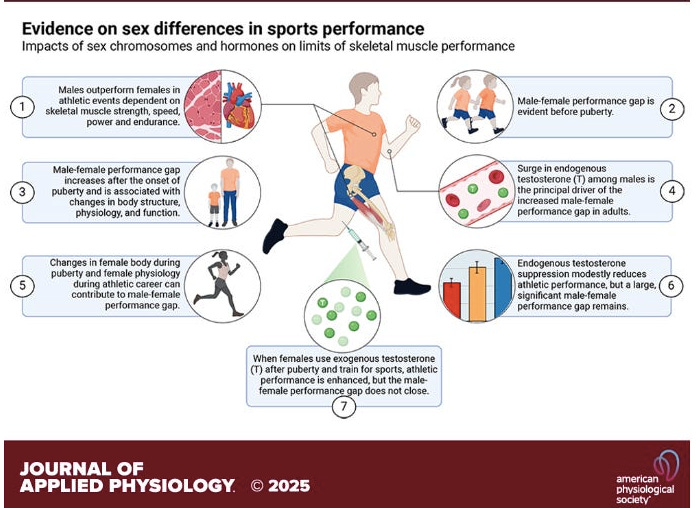
First, males and females differ biologically in numerous ways that directly influence athletic performance. Those differences extend far beyond testosterone and include anatomy, muscle mass, strength, power production, aerobic capacity, hemoglobin concentration, tendon properties, skeletal structure, and many other physiological characteristics.
Second, these biological differences produce meaningful athletic advantages for males when compared with equally aged, equally trained, and equally talented females. Importantly, these advantages are not limited to adults. My own research, along with the work of many other investigators, has demonstrated that measurable performance differences exist even before puberty in running, jumping, throwing, swimming, strength, and other athletic tasks.
Third, the available scientific evidence does not support the claim that puberty blockers, testosterone suppression, or opposite sex hormones eliminate male athletic advantages. These interventions alter some physiological characteristics, but they do not reverse male development or erase the cumulative advantages associated with male physiology. That conclusion has become increasingly well supported as additional studies have been published during the past several years.
When I submitted my first expert reports, these conclusions were often portrayed as controversial. In reality, they reflected well established principles of exercise physiology.
What was unusual was not the science itself, but the reluctance of many scientists to discuss it publicly in such a politically charged environment.
The scientific landscape has changed considerably since then.
Today, organizations including World Athletics, World Boxing, and the International Olympic Committee have all adopted policies recognizing that biological sex remains relevant to fairness in sport. Although their policies differ in important respects, they increasingly acknowledge that lowering testosterone alone does not eliminate male athletic advantages.
The discussion has gradually shifted away from ideology and toward physiology.
Has my involvement in these cases affected me personally or professionally? That is impossible to answer with certainty.
What I can say is that many colleagues have privately told me they agreed with my scientific conclusions but were unwilling to express those views publicly because they feared the professional consequences. I have also had colleagues advise me that I would be better off if I were less outspoken on this issue. Those conversations were often more revealing than any public debate.
I have also encountered resistance during the publication process. On one occasion, a manuscript was rejected because of using the single word “transwomen,” which one reviewer described as a “politically charged right wing dog whistle.” According to the reviewer, the two word phrase “trans women would have been acceptable. In academia, scholarly publications are one of the primary measures of professional success, so editorial decisions like this matter.
I cannot say that I have ever been denied a promotion, position, or professional opportunity because of my work in this area, nor would I attribute every professional disappointment to this issue. However, I have had individuals outside academia tell me they intended to have me fired because of my publicly stated views. Whether any of these experiences ultimately affected my career is impossible to know. The pressure itself, however, was real.
Looking back, I have no regrets about participating in these cases. Scientists should not tailor their conclusions to fit prevailing political fashions. Richard Feynman famously warned that “the first principle is that you must not fool yourself.” Our responsibility is to evaluate the evidence honestly, report it accurately, and follow it wherever it leads.
The Supreme Court’s decision does not resolve every question surrounding transgender participation in sports. Those discussions will undoubtedly continue. What the decision does establish is an important legal principle. States may recognize the biological differences between males and females when creating athletic categories intended to provide fair opportunities for girls and women.
Women’s sports were created because biological sex matters in athletic performance. If males and females performed equally, there would never have been a need for separate athletic categories in the first place.
For decades, society has recognized that reality in virtually every organized sport. The Supreme Court’s decision affirms that states may continue to do so. As someone who has spent a career teaching exercise physiology and several years reviewing the scientific literature for these legal cases, I find that conclusion encouraging, not because it advances one political viewpoint over another, but because it recognizes a principle that lies at the heart of both science and sport: fairness depends upon acknowledging biological reality.
When I first answered my students’ questions in 2019, I never imagined they would lead me to become involved in litigation that would eventually reach the United States Supreme Court. Yet that is exactly what happened. It is a reminder that important national debates often begin with ordinary conversations in classrooms, communities, and homes, and that scientific expertise developed here in Central Nebraska can have an impact far beyond our state.
The author, Dr. Gregory Brown, is a Professor of Kinesiology and Sports Sciences at the University of Nebraska-Kearney.
https://onlinelibrary.wiley.com/doi/10.1002/ejsc.12075

Sarah, thank you for highlighting Dr. Greg Brown. I have been honored to co-author commentaries with him. He is simply amazing, smart, courageous, and just a really nice guy. #GregBrownFan
As someone with 40+ years of coaching women and organizing women only races I think even doing studies to decide if males on drugs or having had surgery could be allowed to compete as females is beyond me. Going down this road was a waste of time.