

Cinephiles are familiar with the nuances between movies that are “based on” or “inspired by” either “actual events” or a “true story.” USA Rugby’s new gender policy is, similarly, inspired by actual sex and based on an applicable Executive Order. But it falls well short of establishing a female category, and is not consistent with the authorities it cites.
As a result, it has created openings for new assaults on female sport.
USA Rugby now recognizes three competitive categories: Men’s, Open, and Women’s. If the Men’s and Women’s categories were, in fact, based on sex then the policy could use the same verbiage to define each, simply switching up the sex-relevant terms, i.e., male and female.
Instead, USA Rugby has three categories and three different ways of defining them.
The Men’s Division is for “any athlete registered as male.” The Women’s division “is limited to individuals who are assigned female at birth.” And the Open division “permits any athlete, regardless of the sex assigned at birth.”
The Men’s Division, then, is two degrees removed from sex. Anyone can enter it, as long as they are “registered” as male. This is USA Rugby’s in-house version of “passport sex.”
The Women’s division masquerades as biologically-based, but the “assigned at birth” construction undermines any claim of objectivity. But it’s worse than simply not understanding the nature of sex (i.e., it’s not “assigned,” ever, by anyone) or falling back on activist phraseology.
The subsequent section of the policy reveals that the basis of Women’s division is self-id:
Division Status will be determined during the membership application and registration process, when an athlete selects the “gender” option in Rugby Xplorer. When applying for membership or registering as “Female” or registering for an event in the Women’s Division, an athlete represents and warrants to USA Rugby that they are Female.
By selecting “Female” as “gender” (the problems are certainly stacking up here), the registrant “creates a rebuttable presumption” of being female. That is, you are what you say you are until someone can prove you are not.
USA Rugby itself is the only entity that can contest or challenge that presumption about an individual’s self-selected inspired-by-sex category. Players, coaches, match officials, league administrators, medical staff or anyone else would have to go all the way up the federation’s hierarchy if they wished to ensure that their women’s team was, in fact, a women’s team and was only competing against other teams of exclusively female athletes.
If USA Rugby agreed to open such a challenge to an individual’s gender registration, the investigation will turn on “records from authoritative sources.” This presumably means government-issued documents like birth certificates or driver’s licenses, both of which have lost their sex linkage in many states. The policy makes no mention of sex screening or any other objective, biologically-based determination.
Finally, USA Rugby’s repeated citation of Executive Order 14201 (“Keeping Men Out of Women’s Sports”) shows how much they want us to believe that they are a fully compliant national governing body, but also that they are making these changes not of their own choosing but because their higher authority (the USOPC) demands it.
However, the policy’s mismatched definitions of the Men’s and Women’s categories are inconsistent with that EO and reveal the desperation behind their attempts to evade responsibility.
Executive Order 14201 takes its definitions from Executive Order 14168 (“Defending Women From Gender Ideology Extremism and Restoring Biological Truth to the Federal Government”). That earlier executive order defines “man” and “woman” as “adult human male / female” (respectively); and then defines “male” and “female” as “belonging, at conception, to the sex that produces the small / large reproductive cell,” respectively.
Notice the chain of binaries here—man / woman, male / female, small / large—and contrast it to USA Rugby’s mushy pairing of “registered as” vs. “assigned at birth.” Those phrases are as incompatible with those executive orders as they are with biology.
“Open” to a hostile takeover
The “Open” category is often mooted as a solution that satisfies the requirements of fairness, safety, and inclusion. Philosopher and friend-of-the-show Jon Pike has argued for sport organizations to adopt “Female” and “Open” categories. Under this framework, only females—defined by the biological binary, and enforced as necessary (or desired) via sex screening—would be permitted in the “Female” category. The “open” category would be for males and any females who did not wish to compete in the female category.
But that is not what USA Rugby did: they created three categories. Almost immediately, trans activists began weaponizing the Open category against the female category and female athletes.
Rugby, despite looking like one of the most intuitively “this is why we sex-segregate” sports out there, is surprisingly trans-captured.
Your Scrumhalf Connection (YSC) is a women’s rugby news site founded and run by two former professional female rugby players. Well, that might have been true two weeks ago, but now it is an incomplete description.
“We aren’t just here to report the news. We are here to organize. If we want a game that remains for everyone, we must make the current policy unworkable.”
YSC described the new policy as “a dark milestone... effectively ending previous medical pathways for trans women,” with the “Open” category being “a ‘separate but equal’ structure,”
By the time I discovered the site on March 4, they claimed a mandate of nearly 300 rugby players who had participated in a virtual meeting on March 2, and accordingly “moved beyond the ‘wait and see’ phase and are now in active mobilization.”
Their first proposed action towards making the policy unworkable “[calls] on every women’s club in the United States to make a radical choice. Direct your club administrators to register your team for the Open Division. If the Women’s Division becomes empty because teams refuse to play without their trans teammates, the policy fails.”
If that proves logistically difficult, they’ll use the Men’s category to do the same.
A suggestion on the YSC’s “#RugbyForAll Open Question” sheet says “With the open division being so ambiguous... [c]an our women’s teams register as a mens team? There is nothing saying players registered as women can’t play for a men’s team. If all women’s teams did this would it not send a bigger message and possibly force policy changes faster?”
Think about that. Think about the physical danger that a single male athlete presents to female athletes in a sport like rugby. This person is proposing putting female players against entire teams of men.
Malice aforethought
These are not original ideas.
Cyclocross might be the most trans-captured of all sports. Last year, a Chicago cycling club created created an “Open” category for their events specifically to tank the women’s category.
Half Acre Cycling doesn’t mince words. “Trans women are women, and the rides and races that we sponsor are always welcoming to trans/femme/non-binary folks who do not identify as a man.”
Lamenting that USA Cycling’s “separate but equal categorization sucks,” they called on women to register for the “open” category and not the women’s category for their upcoming races. This would ensure an adequate field size for riders to get points for USAC standings. They went so far as to say that “[s]plitting up the women’s category into 2 groups is also discriminatory to cis women because in smaller fields it’s harder to upgrade. Women’s fields already had this problem, so support all women racing in the open category to increase field size.”
How racing against men in an “open” category would help female cyclists advance in their sport was, presumably, left to the reader’s imagination.
A prominent and controversial Chicago-area cyclist posted that she would “be choosing to race in the open wave and encouraging my friends to do the same.” But because encouragement has its limits, she adds “there will be a clear divide in where people choose to race.” And, “[i]f a dude decided he wanted to make a point and race in our category he could - but I think it would be met with obvious resistance from our community.”
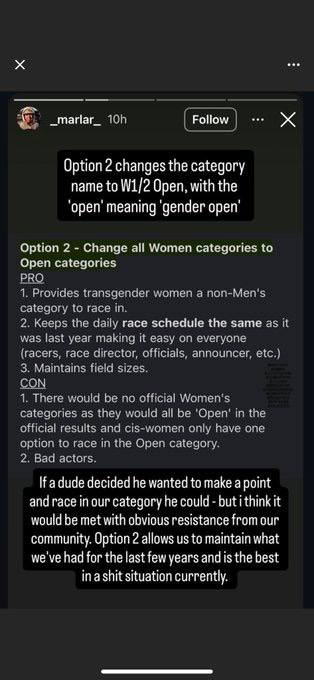
Similarly aggressive tactics show up in Your Scrumhalf Connection’s list of suggested actions.
Remember that USA Rugby reserves the exclusive right to challenge a participant’s gender registration. YSC’s mobilization blueprints include several pages of email templates, one of which encourages “malicious compliance” to “overwhelm the system [and] turn this rule against itself.”
“I am writing to self-report an eligibility concern regarding my own registration status. I request that USA Rugby formally contest my status and establish my eligibility for the Women’s Division through records from authoritative sources as outlined in the policy.”
They are not looking to prove a point via a few test cases.
“If hundreds of athletes force the NGB to verify their records: the administrative cost and time required to enforce this policy will become unsustainable. Make the system buckle under its own weight.”
“Sexclusive” categories protect sport
USA Rugby brought this upon themselves by spurning—more likely, evading—the binary nature of sex. They probably didn’t foresee the administrative version of a dedicated denial of service attack by the chronically aggrieved, hateful, and bored.
But nature has a way of moving towards attractors. Any attempt to talk your way out of the sex binary will ultimately bring you back to some other n=2 categorization.
When offered as a third category, an “Open” division becomes an escape hatch from anything even nominally sex-based. Trans activists hope to use the “Open” division to drain female athletes from the female category. If that doesn’t work, they’ll use the Men’s category against the Women’s.
Mutatis mutandis, their hoped-for outcomes are either a return to the status quo ante, where males were permitted in the female category, or a “trans-inclusive” system where the options are “male” and “open.”
All roads lead to two categories, neither of which is a true female category.
The “female / open” framework at least recognizes the need for a binary based on or inspired by actual sex, and for having one category protected for one sex.
This could be tolerable, and maybe even necessary, as a short-term solution: someone described it to me recently as “a lily-pad towards sanity.” We could call it a gateway drug for reality (gotta ease your way towards that red pill).
However, we should not accept it as a permanent solution, not even as a compromise.
At best, the “open / female” framework is based on actual sex: we know there are two sexes and we want to protect a category for one of them, so we’ll have one sex-protected category.
The biological realities of sex—from its definition all the way through the many attributes of male advantage in sport—are the basis for the female category. There is no such basis for an “open” category.
“Open” is not a sex. Going along with our movie analogy, the “open” category is the equivalent of a composite character: a person who didn’t exist, but their invention reduces the cast of characters and streamlines the screenplay, making it easier on everyone from the screenwriter to the costumer to the producers to the audience.
The “open / female” framework also implies that one sex is default, and one is special; that one is privileged and one is protected.
Sport policy researcher and consultant Cathy Devine argues that this approach “reverts to ‘sport’ & ‘women’s sport’ which female athletes struggled for decades to escape.” In a X exchange with Jon Pike, Ross Tucker, and others, Devine also makes her case against the term “sex protected.” After some synonym suggestions, Devine said “We don’t need ‘protect’, ‘ring-fence’ or any other default from male. ‘Female’ describes the category & the position in it’s entirety. ‘Protect’ and ‘ring-fence’ are superfluous.”
My own synonym search over the days that I’ve been working on this article tended towards “sex-defined” or “sex-identified,” the latter being a way to reclaim “identified” from the trans activists.
More than word choice, though, is the idea that those adjectives should apply to both the male and female categories. Because the two sexes are mutually exclusive, complementary, and equivalent, sex categories in sport should be the same. Both should be defined and restricted according to sex.
Accordingly, and because I do love a portmanteau, I’m laying down my marker for “sexclusive” categories.
Pike and Devine, in their X conversation, recognize the inevitability and, at times, desirability of exceptions to this rule. At the policy level, de jure, there can be no exceptions. But down at pitch level, de facto, there might be. However, any such exception for an athlete to play on a team of the opposite sex would have to be determined by the individual athletes, coaches, and (as applicable) parents, by mutual uncoerced agreement. That is, it would require informed consent.
“Sexclusive” categories do not exclude anyone from sport. Neither do they imply that one category or its members need defending or protecting. They are objective, neutral, and universal, which should be the standards for any policy or law in sport or elsewhere.
That some people find this objectionable and worthy of “by any means necessary” organized opposition is a reminder that these conversations may seem ridiculous, but they are far from frivolous.
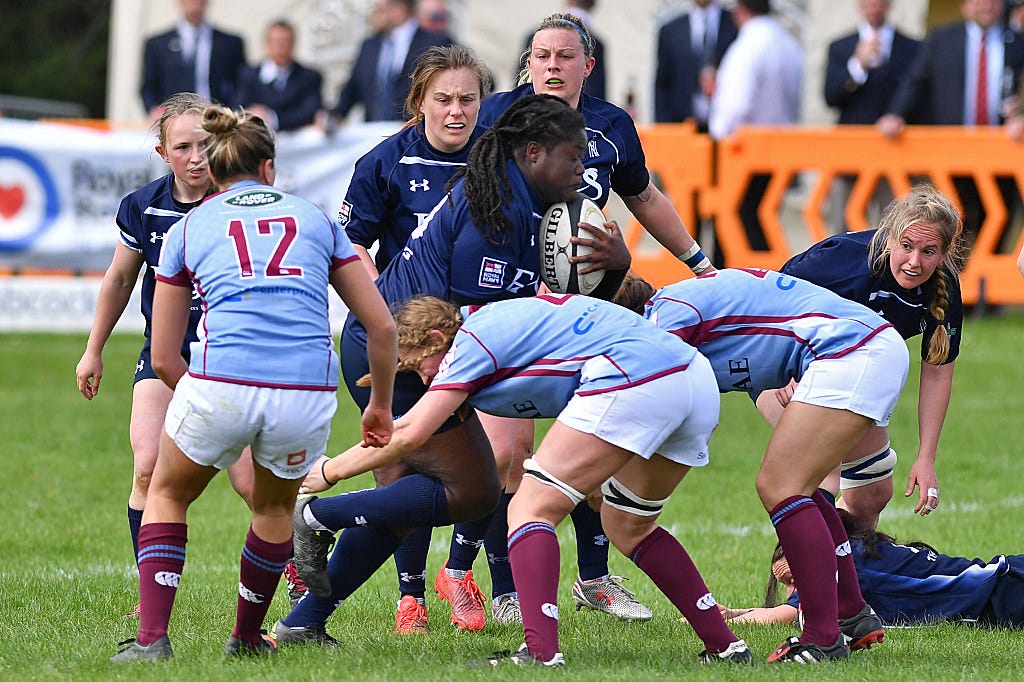
Photo credit: John Walton / Flickr, under CC BY 2.0.
I love a good portmanteau as much as any other linguaphile, but I don't think we need a new word. We need fairness. We need reality. We need common sense. And we need to keep men out of women's sports.
Men. Women. Male. Female.
That's enough.
I'm 65 and remember well the fight to expand girls and women's access to sports. I was the rare female jogger in the early 70's, and my novelty used to get stares. Here we are again, fighting over female access to sports.